
Topical optimisation in SEO means doing SEO for a particular topic or set of topics. Sometimes called semantic SEO. In contrast with, or as a complement, to a more traditional keyword specific optimisation.

Topical and semantic SEO focus on covering a topic as widely as possibly. And with understanding the meaning of a user’s search query, “semantics” and user intent. Semantic SEO focus on extracting meaning and the user intent behind a search query instead of an exact keyword.
Topical vs keyword optimisation
Topical SEO as opposed to keyword optimisation is nothing new. But there isn’t even significant search volume for “topical SEO” or “topical optimisation” in either the classic keyword research tools or Google Trends. The nearest you get is “topical authority”.
That is one more reason for you to get in on the action, now, before it becomes a thing and everyone starts doing it. I have been doing this with clients since at least 2017. In some ways well before it was called that, using Google Search Console as the primary keyword tool.
Keyword optimisation in SEO usually targets a single keyword primarily on each page. Of course, you can optimise for more keywords on a single page, using the same principles as for your primary keyword.
With topical optimisation on the other hand. A page can more easily rank for terms that are used only once on a page or not even used at all. Since the days of Hummingbird at least (2013) Google can rank a page, even at the top of page one for terms that do not appear on the page at all. AI uses synonyms and other user intent factors to display the most relevant content to a user.
What is topical relevancy?
Topical relevance is what the content on a page or all website has in relation to the topic it covers. Topical relevance, also known as topical authority can be achieved by writing well researched or expert content.
Authors or sites that publish content on their topic regularly tend to gain topical authority for the topics and keywords they try to rank for.
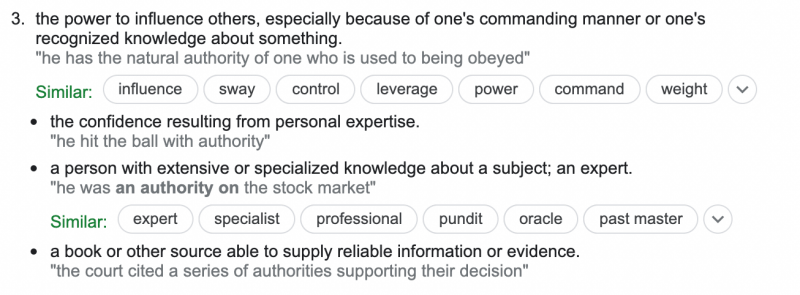
Topical and semantic relevancy is often achieved by pages, sites and authors that cover a topic in depth.
However, topical authority does not require long-form content on every page on a given topic. Answering questions and providing accurate information may make a smaller page more relevant to a user’s query than a long-form one.
This can be particularly true of a cluster page that is supported by and well interlinked with other cluster pages on the topic and the pillar or parent page in the same topic.
It is worth mentioning that we also have passage indexing now. BERT and MUM are clever enough to dig a single paragraph on a page and often display that as a featured snippet or a voice answer.
Passages:
Very specific searches can be the hardest to get right, since sometimes the single sentence that answers your question might be buried deep in a web page. We’ve recently made a breakthrough in ranking and are now able to better understand the relevancy of specific passages. By understanding passages in addition to the relevancy ofthe overall page, we can find that needle-in-a-haystack information you’re looking for. This technology will improve 7 percent of search queries across all languages as we roll it out globally.
Passage indexing on Google
A topical website and topical SEO will naturally make Google and search engines rely less on links from other websites in order to be relevant, than with traditional keyword and exact match anchor text optimisation.
This is because recent and not so recent AI algorithms such as Hummingbird, Rankbrain, BERT and MUM will learn from the actual content on a webpage relying less on the old signals from exact match anchor text in external links and PageRank.
RankBrain is an AI (artificial intelligence) system. RankBrain marks a significant shift in direction from the Google search team. … This is likely to return over time less human maintained and updated algorithms such as the (in)famous Panda and Penguin.
What is Rankbrain
A website that covers its own topic well and relies on authors that have good EAT (authority, expertise, trustworthiness) on their subject may rank well and almost immediately after publishing a piece of content.
How do you build topical relevance?
- begin with keyword research with volumes (the traditional way)
- use GSC (Google Search Console), Google and other tools such as Answerthepublic.com or Alsoasked.com
- build a topical clustering map and ask questions and provide these answers
- build a semantic and topical site architecture, this can look like: mysite.com/guide/topic/subtopic/questionandanswers
- attempt to do as good, better or different from what you see on Google for your topic
- use descriptive anchor text for internal links
- use descriptive anchor text for external links (note the ones you link out to) – linking back from other sites with excessively optimised anchor text is likely to result in algorithmic or even manual penalties
- contrary to what some SEO pandits have argued for years topical authority and relevance have no direct correlation with the number of links or domains pointing to a page or website. From the days of Authorship and Hummingbird to today BERT and MUM, Google has tried to rely less on external links and PageRank to rank pages. Since some tools and warehouses of spammers keep these metrics unreliable as ever
- Topical and domain authority used to, and still do in many people’s eyes have a direct correlation to the number of links, these myths have been and are disseminated primarily by link builders and SEO tools that support them
- you can absolutely build topical relevance on your subject with few links and no active link building, meaning with only the links you earn naturally. A few good relevant links or domains can be more impactful than lots of links from irrelevant or doubtful origins
Stay in your lane (topic)
This is my favourite, you should always try to stay on your topic, it is very easy to deviate and branch out into the neighbouring topics so to speak. i.e. if you are an accountant do not publish content about web design or SEO. If you are a wine seller do not publish long or topical articles on water, milk or fruit juice and so on.
Use the topical cluster model
A big part of a good topic cluster model is the website architecture or contextual hierarchy of your topics.
Topic clusters are groups of related pages or content that cover a wider subject. The topic cluster model can and should be built into the architecture of a website. Beginning at the root with one or various pillar pages, these, in turn, will have cluster pages and subpages. The internal linking of the main pillars and subject clusters will help users and search engines navigate the content and better understand the depth of coverage on a topic.
TL;DR: Influential search engines like Google have changed their algorithm to favor topic-based content. As a result, SEOs are exploring a new way of linking related content under a “topic clusters” model. This report serves as a tactical primer for marketers responsible for SEO strategies.
Topical cluster model in SEO
Do topical and keyword research
By all means, begin with your traditional keyword research. X query with Y search volume per month or year. But this is now just the start. In the old days, you would put these keywords in Yoast or your SEO plugin and optimise the heavens out of it.
Now you need to or would do well to go further and do topical research. Google itself and the SERP are a great place to begin and also tools such as Answerthepublic.com or Alsoasked.com.
This article about topical search results covers a patent from Google that may go some way to explain how contextual searches work. The example about Rocks in the patent also illustrates why staying on your topic is important. If you are a geologist, write about rocks, earth, soil and sand but not about rock music.
Contextual hierarchy and user intent may also explain how Google AI is changing. How search and SEO are less dependent on exact match keywords and links that flow Pagerank. Instead identifies the topics, entities and meaning behind search queries.
Answer the public
Answer the Public has been around for a few years and is a great place to find long term queries and Q&A content ideas, answerthepublic.com. I use these for FAQ structured data but also more generally for finding questions for new content and then providing the answers.
Use query modifiers
While people can search for almost everything through the search engines, a recently conducted study has found that certain terms are used very commonly with each query.These terms are not queries in themselves, but are modifiers to the queries. They are, ‘Who’, ‘What’, ‘Where’, ‘When’, ‘Why’ and ‘How’.
Common Search Query Modifiers
Google Search Console
Use Steve Toth’s Regex in GSC to Find Longtail Keywords and Questions. If this is too advanced for you. An easier way is to simply extract the all data from Google Search Console and pick a few from the queries tab, that you can use in your next blog post or page.
Before we begin, here’s the regular expression for finding questions that begin with “who, what, where, when, why, how, was, did, do, is, are, aren’t, won’t, does, if.”^(who|what|where|when|why|how)[” “]
Using Regex in GSC to Find Longtail Keywords and Questions
Internal linking in a topic cluster model
Internal linking is a major part of on page SEO and has gained some voice lately in many blogs and social chats. In its simplest form, internal linking in topical optimisation should ensure the pillar pages on the topics link to all relevant cluster pages.
These cluster pages should, in turn, link back to the parent/pillar page and where relevant between each other.
No paragraph on internal linking would be complete without mentioning anchor text. The text that wraps the link should be descriptive of the page or section of the page it is linking to, thus making it easier for us and search engines to understand what the page linked is about.
While this applies to external links too, and you should use the same anchor text principles to any external links. However, this is not carte blanch for building links from another site with exact match anchor text.
As that can easily spoil all efforts and be seen as spam. The bottom line, you should hope that any links your site or page gets are relevant and use descriptive anchor text. You just should not do it yourself.
Leverage user intent and Semantic SEO
The user intent, or search intent states which goal or intention an internet user has when entering a search term into a search engine. User intent is now a central factor in content and search engine optimization and is eclipsing individual keywords as a dominant ranking factor.
User intent on Google
SEMrush has recently introduced the user intent feature in its keyword research tool. It is not perfect but a good first shot for many queries.
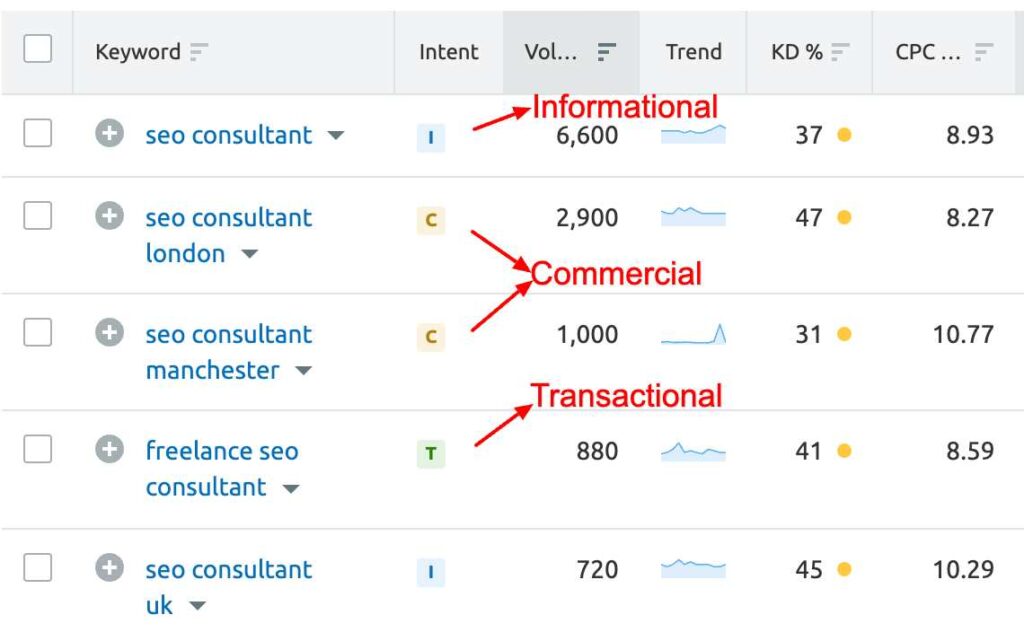
Looking at the query SEO consultant and SEO consultant London, it classes the former as informational and the latter Commercial. With Freelance SEO consultant as Transactional. This may not be 100% correct but I agree that on most occasions SEO consultant searchers are not actually looking to hire an SEO. At least not as much as with the location included as with SEO consultant London or Manchester.
How to target different user intent queries? Read How To Target Search Query Types In SEO.
Additional tools for user intent research Systryx and a new AI based tool keywordinsights.ai.
Spread the topic
This is a good way to assert your own topical expertise and relevance. And by doing so you probably will get all the links you need in a truly natural way. For example, all the external links in this post are there due to the merits of the content and authors, not because they paid me or offered any other incentive to link to them.
On that note you if you enjoyed this post consider sharing it with your social crowd or add any views or tools I may have missed in the comments below.
