
AI search has already produced a flood of acronyms: AI SEO, LLM SEO, AI Search, AEO, GEO and the list goes on with a long tail of recycled SEO concepts dressed up as new disciplines. Some of these terms describe genuinely useful changes in how people search, how answers are generated and how brands are surfaced across Google AI Overviews, ChatGPT, Perplexity, Claude and other AI search interfaces.
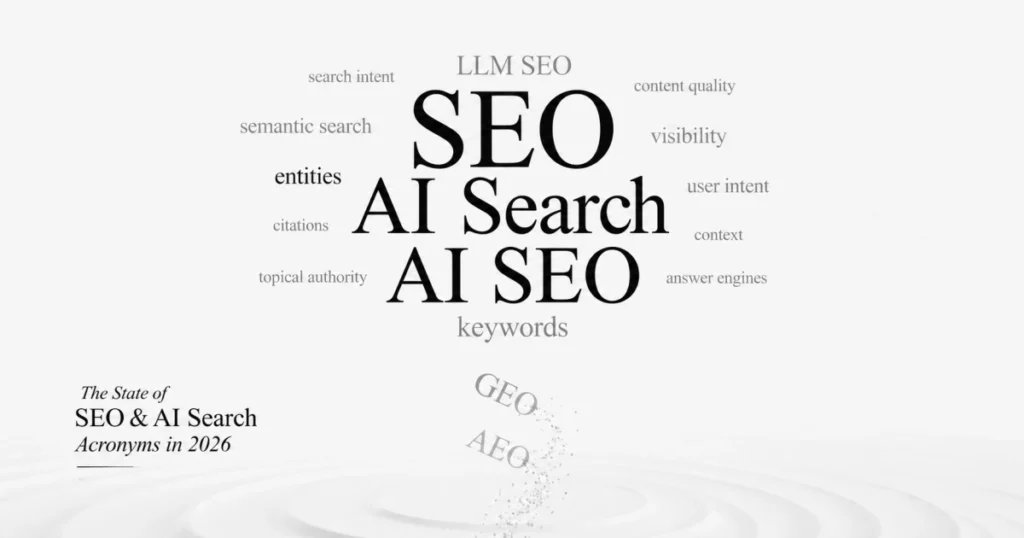
Others are simply good SEO under a new label. And some exist mainly to sell services to buyers who do not yet know enough to question the terminology.
My view is that the market will eventually settle around two durable terms: AI Search and AI SEO. The rest may still appear in pitches, conference decks and keyword tools, but most are unlikely to survive as clear commercial categories. Both GEO and AEO have a credibility and acceptance problem. Bing has GEO guides while Google and many SEOs do not endorse or recognise it.
This post maps the current acronym landscape using keyword research, search demand, referral traffic data and practical SEO context. The aim is not to invent another label, but to separate what is commercially grounded from what is premature, inflated or already drifting into spam.
Keywords vs Entities and Intent
Isn’t AI Search all about entities and intent, not keywords? Yes, but that does not make keywords irrelevant. Entities and user intent help AI systems understand meaning, context and relationships. Keywords still matter because they are part of the SEO layer that feeds search engines, retrieval systems and RAG-based answers.
The mistake is treating keywords as the whole strategy. In AI Search, keywords are signals. Entities, intent, content quality and source credibility decide whether those signals become useful visibility.
SEO Is Still King. The Data Is Not Even Close.
Before the acronyms, the terminology debates and the LinkedIn posts declaring SEO dead, it is worth starting with the actual numbers, because the gap between the industry narrative and the real data is striking.
Google is still far larger than ChatGPT as a search environment, but the exact ratio depends on how “search” is defined. Older estimates comparing Google-like ChatGPT searches to Google Search put Google hundreds of times ahead. Newer Ahrefs analysis gives a narrower comparison, estimating ChatGPT at around 12% of Google’s traditional search-like query volume, while Google still sends around 190 times more traffic to websites.
SparkToro and Datos provide a different, and arguably more useful, view of where search behaviour happens. In Q4 2025, Google alone accounted for 73.7% of all desktop search activity across the 41 major domains analysed in the US. Their analysis also found that Amazon, Bing and YouTube each had more search activity than ChatGPT.
| What it says | Useful angle |
|---|---|
| Google = 73.7% of desktop searches across 41 major US sites | Google still dominates, but not 90%+ when “search” is measured more broadly |
| Traditional search engines = around 80% of searches | Search is not just Google, but Google still leads |
| AI tools = 3.2% of searches/prompts | AI Search is growing, but still small in search behaviour terms |
| EU/UK: Google is more dominant, around 80% in this broader model | Better for UK/London angle |
| Amazon, Bing and YouTube had more desktop search activity than ChatGPT | Good anti-hype point |
Ahrefs gives a useful counterweight to the older “Google is 210x bigger than ChatGPT” framing. Its 2026 analysis estimates Google at around 13.7 billion searches per day, compared with 2.5 billion ChatGPT prompts per day.
However, not every ChatGPT prompt is a search. Ahrefs estimates that around 65% of ChatGPT prompts are search-like, which would put ChatGPT at roughly 1.625 billion search-like prompts per day, or about 12% of Google’s daily search volume. That is no longer tiny, but it is still not a Google replacement.
More importantly for SEO, Ahrefs also estimates that Google sends around 190 times more referral traffic to websites than ChatGPT, which is the point many AI Search headlines conveniently skip.
| Metric | Ahrefs figure |
|---|---|
| Google searches per day | 13.7bn |
| ChatGPT prompts per day | 2.5bn |
| Estimated search-like ChatGPT prompts | 65% |
| Search-like ChatGPT prompts per day | 1.625bn |
| ChatGPT search-like volume vs Google | 12% |
| Google vs ChatGPT search-like volume | around 8.3x larger |
| Google traffic referrals vs ChatGPT | around 190x larger |
Google Posted the GEO Job Listing
On 22 April 2026, Google posted a job listing for a GEO Partner Manager. The role, within Google’s Large Customer Sales team, is focused on managing relationships with what Google calls “GEO players” and transitioning Google’s engagement model from Generative Engine Optimisation discovery to formal ecosystem advocacy.
The reaction in the SEO community was immediate and divided. Some read it as official validation of GEO as a discipline. Others, with some justification, pointed out that Google using GEO internally to describe a partner management role tells us more about Google’s advertising strategy than it does about whether GEO deserves a place in your service offering.
The Google GEO Partner Manager job listing was short lived and very telling of how Google pulled it back in no time. The Search Engine Roundtable discussion it generated is also worth reviewing for the range of community reactions.
What it does not resolve is the underlying question of whether GEO, as a practitioner-facing term, has meaningful commercial traction. The keyword volume data suggests it does not, and for reasons that go beyond search volume alone.
Reading the Keyword Volume
Search volume around these terms is a proxy for commercial legitimacy. When SEOs, business owners and marketers actively search for a term, they believe it describes something real and useful. Low or contaminated volume tells the opposite story.
AI SEO cluster, dominant, with clear commercial intent:
Note on Monthly Volume: xx = 10 to 99, xxx = 100 to 999, x,xxx = 1,000 to 9,999”. Figures from Ahrefs, April 2026. Treat as directional rather than definitive, run your own research before drawing conclusions.
| Term | Monthly Volume |
|---|---|
| AI SEO agency | x,xxx |
| AI SEO | x,xxx |
| SEO AI | xxx |
| AI SEO services | xxx |
| AI SEO company | xxx |
| SEO AI agency | xxx |
| AI for SEO | xxx |
| AI search SEO | xxx |
| AI SEO consultant | xxx |
LLM SEO cluster, smaller, technically specific, and growing:
| Term | Monthly Volume |
|---|---|
| LLM SEO | xxx |
| LLM SEO agency | xxx |
| LLM SEO optimisation | xxx |
| LLM SEO services | xxx |
| LLM SEO consultant | xx |
Data from Ahrefs in April 2026.
GEO and AEO + Consultant have low volume, and the volume that exists is not what you think. Granted there is significant volume for “GEO Agency” but a big portion is about Geography and Geographic Information Systems agencies not Generative Engine Optimisation or AI search.
That alone explains why AI Search is a strong entity and GEO a very weak one within SEO, precisely because it was a very strong entity already. Not to mention this all comes under the politics of SEO, or SEO politics. Now lets try and do that with GEO… you see where this is going, quite timely too, we have enough messy Geopolitics as it is.
A significant portion of AEO search volume belongs to the AEO Pakistan entity: an Islamabad-based education consultancy focused on IELTS and OET testing with no connection to digital marketing. The term is not just low volume; it is actively polluted by an unrelated entity that now dominates much of the search space around it.
Where the Terminology Actually Stands
SEO Consultant
Volume: Established. Intent: Clear. Legitimacy: Foundational.
Twenty-five years old, the most commercially trusted and clearly understood term in this space. The consultant or agency who still leads with SEO is not behind the curve. The question is simply how they articulate the AI dimension of their work within that frame.
But there are some dismissing AI Search altogether, and that’s naive too. LLM and AI search are not in any way comparable to MUM, Hummingbird or any other changes in the past decade and half.
Demis Hassabis of Google DeepMind and many others predicts AI and LLMs will be Bigger than the Industrial Revolution.
AI SEO
Volume: High. Intent: Clear. Legitimacy: Strong.
The dominant cluster in the data, and the most commercially mature of the AI-era terms. “AI SEO” covers two related things: using AI tools within an SEO workflow, and optimising content so it surfaces in AI-powered search results. Both meanings are grounded in existing SEO practice rather than departing from it.
This is where the market has landed. Businesses looking for help with AI and search are searching for AI SEO. The expectation is that as the market matures, most of the other terms in this list will consolidate under AI SEO as an umbrella, in the same way that mobile SEO, local SEO and voice SEO eventually stopped being separate disciplines and became components of core SEO practice. AI SEO is the new layer on top of SEO, not a replacement for it.
But for now it does not separate AI Search from traditional SEO cleanly, this may change in the future as concepts get established.
LLM SEO
Volume: Growing. Intent: Technically Specific. Legitimacy: Genuine.
LLM SEO focuses specifically on how large language models, the technology behind ChatGPT, Gemini, Claude, Perplexity and others — understand, process and surface content. Understanding how a language model builds topical authority is genuinely different from understanding how PageRank works, and that difference is sufficient to warrant distinct terminology.
The audience searching LLM SEO is smaller but more technically literate: developers, senior consultants, in-house strategists. That is not a weakness. It is a signal that the term describes something specific and real. LLM SEO is a legitimate subspecialty within AI SEO rather than an alternative to it.
The honest caveat: because LLMs do not publish their source weighting the way Google publishes guidelines, much of what is presented as LLM SEO expertise is inference and experimentation rather than documented methodology. SEOs who acknowledge this openly are the credible ones.
AI Search
Volume: Moderate and Rising. Intent: Broad. Legitimacy: Contextual.
“AI Search” captures the broader shift in how search is working: the move from blue-link results towards generative, conversational interfaces. It sits higher in the purchase funnel than LLM SEO. Someone searching “AI search SEO” is often trying to understand the landscape before they know exactly what kind of help they need.
The reasonable expectation is that this volume consolidates into “AI SEO” as the market matures. AI Search is a useful descriptive term for the current moment rather than a durable professional positioning.
AEO Answer Engine Optimisation
Volume: Low and Contaminated. Intent: Ambiguous. Legitimacy: Fragmented.
AEO now carries an additional layer of confusion that was not present twelve months ago: the A no longer stands for just one thing. In 2026, AEO is being used to mean both Answer Engine Optimisation (structuring content for direct answers in search results and AI systems) and Agent Engine Optimisation (optimising for visibility and citation within autonomous AI agents). Answers is dominant but 26 and 27 may well reverse this.
Both concepts describe genuinely useful practice. Answer-focused content structuring has been part of mature SEO for years, how much of this is new and AI, is another matter altogether.
The growing world of AI agents, which increasingly query, cite and act on web content without human direction, is a real and emerging consideration. But the term serving both concepts simultaneously is, at best, confusing and at worst, commercially unusable.
Add the AEO Pakistan entity, which now occupies a significant share of the actual search space around the term, and you have a term whose problems are structural rather than temporary. The principles of AEO belong in any serious content strategy. The term itself is doing nobody any favours.
AEO Agentic Engine Optimisation
There may be a more legitimate future use for AEO as Agentic Engine Optimisation than as Answer Engine Optimisation. AI agents have begun searching, comparing, selecting suppliers, booking services, filling baskets or making recommendations on behalf of users, then visibility inside those agent-led workflows becomes a real optimisation problem.
That is different from simply formatting content for answers. It involves crawlability, structured data, product feeds, entity confidence, trust signals, reviews, pricing clarity, policies, availability and whether an agent can complete or recommend an action without hitting friction.
In that sense, Agent Engine Optimisation may become a more useful concept than Answer Engine Optimisation, but it is still early, loosely defined and competing with an already confused acronym. Confused? You should be.
Nerdy? Most likely yes if you got this far. This tool: https://isitagentready.com. tests whether your site is agent-ready. Keep your agents in a row.
GEO Generative Engine Optimisation
Volume: Low and Contaminated. Intent: Mixed. Legitimacy: Academic in Origin, Commercially Premature.
GEO originated in legitimate academic research: a 2023 paper from Princeton that coined the term and outlined a framework for optimising content for generative AI search results. The concept has genuine intellectual rigour behind it.
What followed is the familiar pattern. A legitimate academic idea gets adopted by the content marketing industry, stripped of its caveats, and deployed as a competitive differentiator by agencies looking to establish positioning ahead of the market. Much of the resulting content sits in the “SEO is dead” genre, which continues to generate output and attention in rough inverse proportion to its accuracy.
The Google GEO Partner Manager listing does add a data point here. Google using the term internally, even in an ad sales context, gives GEO a form of institutional acknowledgement it previously lacked. Whether that translates into buyer recognition or search volume is a different question, and the current data suggests not yet.
GEO as a concept: worth understanding. GEO as a professional positioning in 2026: primarily serves the people promoting it.
The Thesis: Consolidation, Not Fragmentation
The most useful frame for what is happening to this terminology is not disruption. It is consolidation.
Every previous SEO specialisation that generated its own terminology cycle, mobile SEO, local SEO, voice search, structured data, Core Web Vitals, eventually stopped being a standalone discipline and became absorbed into what SEOs simply do. The techniques persisted. The separate branding faded. The SEOs who understood both the fundamentals and the new context emerged stronger.
AI search is following the same trajectory, at higher speed and with more noise. The terms that will persist are the ones with genuine search demand behind them: AI SEO as the dominant umbrella, LLM SEO as a legitimate technical subspecialty, AI Search as a descriptive category for the transitional moment we are in.
GEO and AEO describe real principles that will remain part of good practice; the terms themselves are unlikely to outlast the current hype cycle in their current form. They already have a reputation issue and are either SEO repackaged or mostly Listicles and Content Scale Abuse that are exactly the same things black hat SEOs were selling in 2010 before Panda and Penguin. And to this day as well.
The data supports this. Buyers are not searching for GEO or AEO consultants. They are searching for SEO consultants who understand how AI changes search. That is the brief. The terminology should reflect it. I have been busy with SEO recovery services exactly from this type of “GEO” and AI work, where clients killed years of good SEO work and Google Search results (about ~90%). In the pursuit of the other 10% with ChatGPT and other LLMs,
